
Does Acacia Collagen Really Help Thicken the Appearance of Hair?
Share
If you have ever searched for how to make your hair look thicker or how to get fuller hair naturally, you have probably come across acacia collagen as an ingredient. But does it actually work? And how does it compare to the marine or bovine collagen supplements you see everywhere? Here is a straightforward, science-backed answer.
The question of how to thicken hair and how to make hair look fuller sits at the intersection of cosmetic chemistry, trichology, and consumer wishful thinking. There is a lot of noise in this space. This post is not interested in noise. We have looked at the peer-reviewed research, and the picture is genuinely interesting.
First: What Is Acacia Collagen, and Why Is It Called Collagen?
Acacia collagen is not a collagen in the conventional sense. It is not derived from animal connective tissue. It does not contain the amino acid chains found in marine or bovine collagen. The name reflects its functional behaviour, not its molecular origin.
Acacia collagen is extracted from the hardened sap of the Acacia Seyal tree, which grows across East Africa and the Sahel Zone. The extract is a complex mixture of arabinogalactan oligosaccharides and glycoproteins: polysaccharide chains rich in galactose and rhamnose, with an attached protein fraction. It is this protein-polysaccharide structure that gives it collagen-like behaviour in cosmetic applications.
It is plant-derived, vegan, cruelty-free, and sustainably harvested by local farmers from wild trees. For those of us who care about what goes into a formula as much as what it does, that matters.
The Key Distinction
Marine and bovine collagens are ingested supplements. They are broken down in the gut and circulate as amino acid peptides. Acacia collagen is a topical cosmetic ingredient. It works directly on the hair fibre and scalp surface. These are fundamentally different mechanisms, and conflating the two is one of the most common sources of confusion in this category.
How Does Acacia Collagen Work on Hair?
When applied topically, acacia collagen works through three distinct mechanisms that collectively contribute to the appearance of thicker, fuller hair.
1. Film-forming and swelling of the hair shaft
The arabinogalactan fraction of acacia collagen is a highly water-binding polysaccharide. When it contacts the hair fibre, it forms a fine, flexible film around the shaft. This film is not occlusive in the way a silicone coating is. It absorbs moisture from the environment and retains it within the film layer, which causes the film itself to swell slightly. The practical effect is a measurable, temporary increase in hair shaft diameter. Hair that was fine or flat appears visibly fuller. This is the primary mechanism by which acacia collagen makes hair look thicker.
2. Cuticle smoothing and surface integrity
The glycoprotein fraction of acacia collagen is particularly relevant for damaged hair. Damaged hair cuticles are lifted, jagged, and uneven. This roughness contributes to frizz, tangling, and the visual appearance of thin, limp hair. The glycoproteins in acacia collagen interact with the exposed surface of the cuticle, filling micro-gaps and smoothing the fibre surface. When light reflects from a smoother surface, hair appears shinier and, visually, more dense.
3. Scalp-level antioxidant and anti-inflammatory activity
Research published on the properties of Acacia seyal gum extract confirms antioxidant and anti-inflammatory activity at the tissue level. Oxidative stress at the scalp is now well established as a contributor to follicle miniaturisation and premature hair ageing. A scalp environment under lower oxidative stress supports a healthier follicular cycle, which over time can contribute to hair that grows in fuller and at a healthier calibre.
Where You Will Find It: GF Fabulosity Energising Range
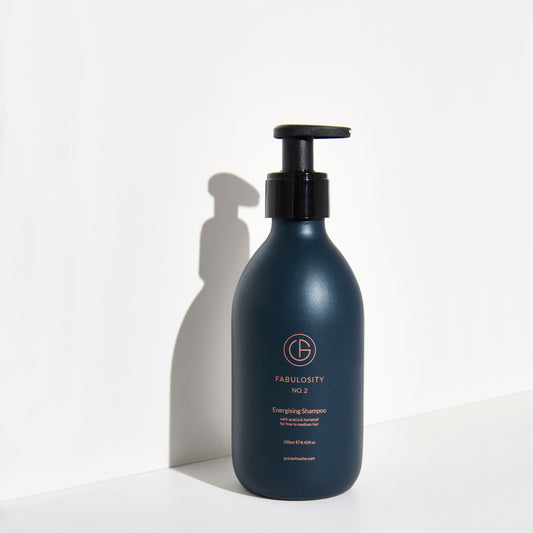
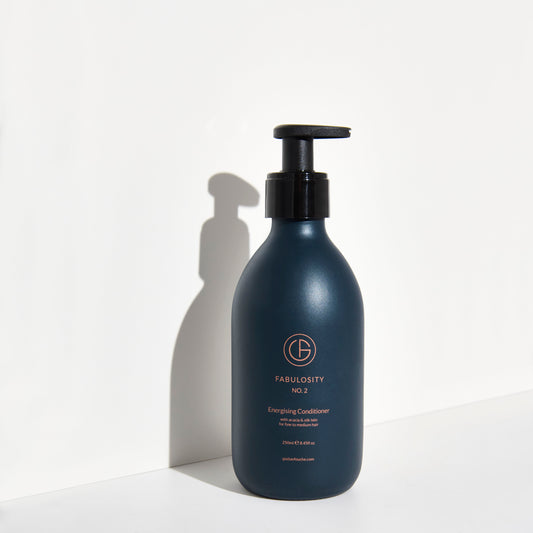
Acacia Collagen (listed on the INCI as Acacia Seyal Gum Extract) is a key ingredient in both the GF Fabulosity Energising Shampoo and Energising Conditioner. It sits alongside Panthenol, Hydrolyzed Wheat Protein, Horsetail Extract, Chamomile Extract, and Carrot Seed Oil in a formula built for energised, fuller-looking hair from root to tip. The Energising range is silicone-free, meaning the acacia collagen film can form freely on the hair shaft without competing with synthetic coatings.
What Does the Research Say?
The broader scientific literature on collagen peptides and hair is genuinely compelling, and it is directly relevant to understanding why acacia collagen works.
PubMed Research — Collagen Peptides and Perceived Hair Thickness in Humans
A randomised, double-blind, placebo-controlled clinical trial (Reilly et al., published in Dermatology Research and Practice, 2024, PubMed ID 39021368) found that after 12 weeks of daily hydrolysed collagen supplementation, 66.7% of participants in the treatment group reported that their hair felt thicker, compared to 44.2% in the placebo group — a statistically significant difference. The study also measured improvements in the perceived healthy appearance of hair, with the collagen group showing a 31.9% improvement versus 9.4% for placebo.
Source: Reilly et al., Dermatology Research and Practice, 2024 — pubmed.ncbi.nlm.nih.gov
Science Direct — film forming capabilities of Acacia Seyal
This 2023 study showed the many relevant properties of Acacia Seyal, or Collagen, ranging from its ability to form a polysaccharide and glycoprotein film and its hydrophilic properties of retaining moisture.
Source: Phillips et al., Sustainable Chemistry and Pharmacyl, 2023 — sciencedirect.com
The picture that emerges across this body of research is consistent: collagen-derived actives, applied topically or supplemented orally, measurably improve hair shaft diameter, surface integrity, and perceived thickness. The mechanisms are well characterised. The human clinical evidence is growing.
Acacia Collagen vs Marine and Bovine Collagen: What Is the Real Difference?
This is probably the question we hear most. Here is a clear, honest comparison.
| Property | Acacia Collagen | Marine Collagen | Bovine Collagen |
|---|---|---|---|
| Source | Acacia Seyal tree sap (plant-derived) | Fish scales or skin | Cow hide or bone |
| Vegan | Yes | No | No |
| Cruelty-free | Yes | No | No |
| How it is used | Topical — applied to hair and scalp | Oral supplement, ingested | Oral supplement, ingested |
| Mechanism on hair | Film-forming, shaft swelling, cuticle smoothing, antioxidant at scalp | Peptides circulate via bloodstream, stimulate fibroblast collagen production, support follicle environment | Similar to marine but lower bioavailability due to larger peptide size |
| Speed of visible effect | Immediate to short-term (shaft swelling), longer-term via scalp health | Weeks to months — systemic pathway is slower | Weeks to months |
| Best for | Topical hair care — thickening, hydration, smoothing, scalp support | Systemic support for skin, scalp, and hair from within | Systemic support, often used for joints and skin |
| Evidence base for hair thickness | Strong mechanistic evidence; film-forming and shaft-swelling properties well documented | Growing clinical evidence — several RCTs show improvement in perceived thickness and shaft diameter | Less targeted hair research; benefits mostly extrapolated from skin studies |
The important point is that acacia collagen and ingested collagen supplements are not competing with each other. They work through completely different routes. Using an acacia collagen-containing topical product and supplementing with marine collagen is not redundant — these are complementary approaches acting at different points in the hair health picture.
"The question of how to make hair look thicker is not one question. It is at least three: how to swell and coat the shaft, how to support the follicle environment, and how to protect against the oxidative stress that ages hair from the inside out."
Who Benefits Most from Acacia Collagen in Hair Care?
The published research and the cosmetic science both point to the same populations who see the greatest benefit from topical acacia collagen.
Fine or low-density hair. If your hair has always been on the finer side, the shaft-swelling mechanism of acacia collagen provides an immediate visual improvement in fullness. Because each strand has a slightly larger diameter after application, the overall visual density of the hair increases.
Damaged or over-processed hair. Bleaching, colouring, heat styling, and chemical processing all compromise cuticle integrity. The glycoprotein fraction of acacia collagen specifically addresses this, smoothing the cuticle surface and improving the way light reflects from the fibre. Hair that has been dulled by damage looks visibly more alive.
Hair experiencing hormonal change. The miniaturisation of hair follicles that accompanies perimenopause and menopause results in finer, sparser strands over time. Reducing oxidative stress at the scalp supports the follicular environment at exactly the stage of life when it needs the most protection. While no topical ingredient can fully reverse follicle miniaturisation, creating the best possible scalp conditions is a meaningful part of hair longevity strategy.
Those seeking genuinely clean, natural formulations. Because acacia collagen is plant-derived, biodegradable, and sustainably sourced, it belongs naturally in silicone-free, cruelty-free formulations. The collagen-like benefits it delivers do not require any animal derivatives or synthetic film-formers. It is exactly why Acacia Seyal Gum Extract features in the GF Fabulosity Energising Shampoo and Conditioner — a range formulated for hair that needs visible volume and energy, without the silicone crutch that most volumising products rely on.
A note on expectations: Acacia collagen will give you visibly fuller, smoother, better-behaved hair from the first use. It will not regrow hair that has already been lost from the follicle. What it does is improve the quality and appearance of the hair you have, and over time, support the scalp conditions that allow your hair to grow at its best calibre.
Frequently Asked Questions
How can I make my hair look thicker naturally?
The most effective natural approaches are topical ingredients that swell and coat the hair shaft — acacia collagen being one of the best studied — combined with scalp-first care that supports healthy follicle cycling. Protein-rich ingredients like wheat protein and amaranth protein also contribute to the structural integrity of each strand, which affects both thickness and resilience.
Can topical ingredients actually thicken hair, or is it just an illusion?
Both, depending on the mechanism. Film-forming ingredients like acacia collagen genuinely increase the physical diameter of each hair shaft by swelling the coating around the fibre. This is a real, measurable change in shaft diameter — it is just not permanent. Ingredients that improve the scalp environment and support stronger keratin production contribute to long-term hair quality. The published research on collagen peptides documents genuine improvements in shaft diameter in clinical settings.
Is acacia collagen the same as taking collagen supplements?
No. Acacia collagen is a plant-derived topical ingredient that works on the surface of the hair fibre and scalp. Collagen supplements are animal-derived proteins taken orally that are digested and circulate as peptides in the bloodstream. Both have evidence supporting hair benefits, but through entirely different mechanisms.
How long does it take to see results from acacia collagen in haircare?
The film-forming and shaft-swelling effects are visible from the first use — your hair will feel and look different after a single wash. The longer-term benefits to scalp health and cuticle integrity build over regular use of several weeks.
Is acacia collagen safe for all hair types?
Yes. Acacia Senegal gum and Acacia Seyal gum extract have both been assessed by the Cosmetic Ingredient Review and are confirmed safe for use in cosmetic products. The ingredient is non-comedogenic, non-toxic, and has a strong safety record across a wide range of formulation types.
What makes hair look thin and flat?
Several factors contribute: fine strand diameter (genetic), reduced density over time (hormonal or stress-related), silicone buildup that weighs strands down and prevents them from holding volume, cuticle damage that flattens and dulls the fibre, and scalp conditions that compromise the follicular environment. A scalp-first, silicone-free approach addresses several of these at once.
The Short Answer
Yes. Acacia collagen does genuinely contribute to the appearance of thicker, fuller hair. The film-forming mechanism is well established in cosmetic science. The glycoprotein fraction improves cuticle integrity. And the antioxidant activity at the scalp supports the follicular environment over time. It is not magic, but it is real, plant-based, and peer-reviewed.
Try Acacia Collagen in the Energising Range
The GF Fabulosity Energising Shampoo and Conditioner are both formulated with Acacia Collagen Extract, silicone-free and cruelty-free, built for hair that needs genuine volume and vitality rather than a synthetic coating.
Shop the Energising Range